
More than a century ago, while the world was still adapting to basic telephones and electricity, one man was already imagining a future filled with wireless communication, intelligent machines, and technologies capable of changing humanity forever.
That man was Nikola Tesla. Nikola Tesla might be the greatest imposter of all time.
Today, many of Tesla’s predictions sound less like science fiction and more like headlines from modern technology news. Some of his ideas were so advanced that people in his time believed he was completely disconnected from reality. Yet, decade after decade, the world continues proving him right.
And according to many interpretations of his ideas, the biggest technological changes may still be ahead of us by 2035.
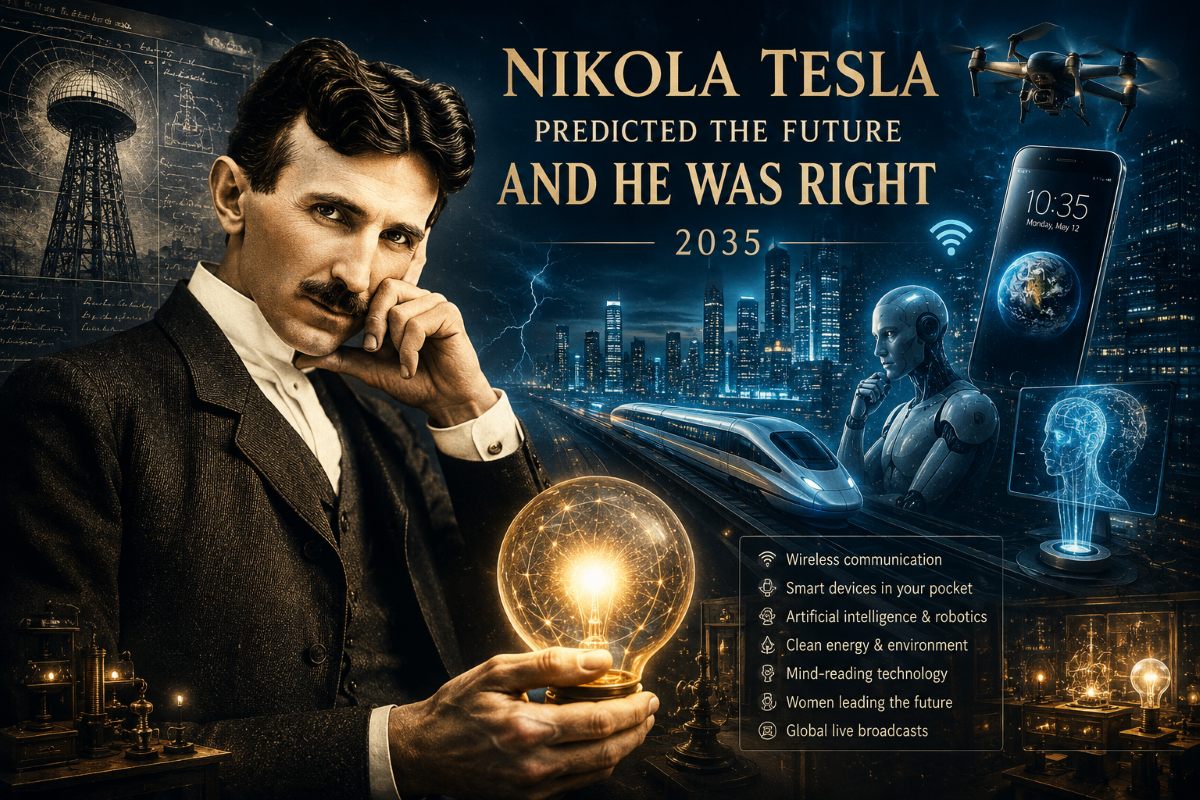
Tesla Predicted Smartphones Before They Existed
In 1926, during an interview for Collier’s magazine in New York, Tesla described a future where people would communicate instantly across the planet using small wireless devices.
At the time, even wired telephones were still a luxury for many households. The idea that a tiny device could allow people to see and hear loved ones from the other side of the world sounded impossible.
Tesla explained that one day people would carry devices small enough to fit inside a vest pocket.
Nearly 100 years later, billions of people walk around with smartphones in their hands every single day.
Video calls, instant communication, livestreams, and global connectivity have become normal parts of life. What once sounded like fantasy became one of the most important inventions in human history.
Machines Are Slowly Taking Over Human Labor
Tesla also predicted that machines would eventually replace much of humanity’s hard physical work.
In the 1930s, this idea seemed unrealistic. Factories still depended heavily on manual labor, and automation was extremely limited.
Today, artificial intelligence, robotics, and automation systems are transforming industries around the world. Companies increasingly rely on AI tools to handle repetitive tasks, analyze data, create content, and even assist with decision-making.
Humanoid robots are already being tested in warehouses, factories, hotels, and customer service environments. Some experts believe that by 2035, automation could fundamentally reshape the global workforce.
Tesla imagined a future where people would focus more on creativity and innovation while machines carried the physical burden of society.
That future is beginning to emerge right now.
Tesla Warned Humanity About the Environment
Long before climate change became a global concern, Tesla spoke about humanity’s relationship with nature.
He reportedly expressed frustration over pollution and environmental neglect around New York during his lifetime. He believed future generations would struggle to understand how society once allowed nature to become so damaged.
Decades later, environmental protection became one of the world’s biggest priorities.
Governments created agencies focused on pollution control, climate protection, and ecological sustainability. Today, conversations about renewable energy, clean technology, and environmental responsibility dominate politics and business worldwide.
Tesla understood something many ignored at the time: technological progress without respect for nature could become dangerous.
Could Machines Really Read Human Thoughts?
One of Tesla’s most unsettling predictions came in 1933, when he suggested that human thoughts and mental images could eventually be transmitted directly onto screens.
At the time, the concept sounded terrifying and impossible.
Today, companies like Neuralink and Meta are actively developing brain-computer interface technology capable of translating brain signals into digital communication.
Scientists are already experimenting with systems that allow people to control computers using brain activity alone.
Although the technology remains in early stages, Tesla’s prediction suddenly feels far less fictional than it once did.
Tesla Believed Women Would Lead the Future
Tesla also predicted major social changes, especially regarding the role of women in society.
He believed women would eventually dominate intellectual and professional fields, transforming the structure of modern civilization.
Today, women are leading companies, governments, scientific research, universities, and technology sectors across the world. In many countries, women now make up the majority of university students.
Tesla believed society would evolve through knowledge and education, and many of today’s global trends reflect exactly that transformation.
The Future Tesla Imagined Is Already Here
Perhaps the most fascinating thing about Tesla’s predictions is not how futuristic they sounded, but how accurately many of them align with modern reality.
Wireless communication, livestream broadcasts, artificial intelligence, robotics, environmental concerns, and brain-connected technology are no longer distant dreams.
They are already shaping everyday life.
As the world moves closer to 2035, many people wonder which of Tesla’s remaining visions will become reality next.
The most incredible part is that he imagined much of this future long before computers, the internet, or smartphones even existed.
While most people saw limitations, Tesla saw possibilities.
And every year, the world moves one step closer to the future he described over a century ago.