
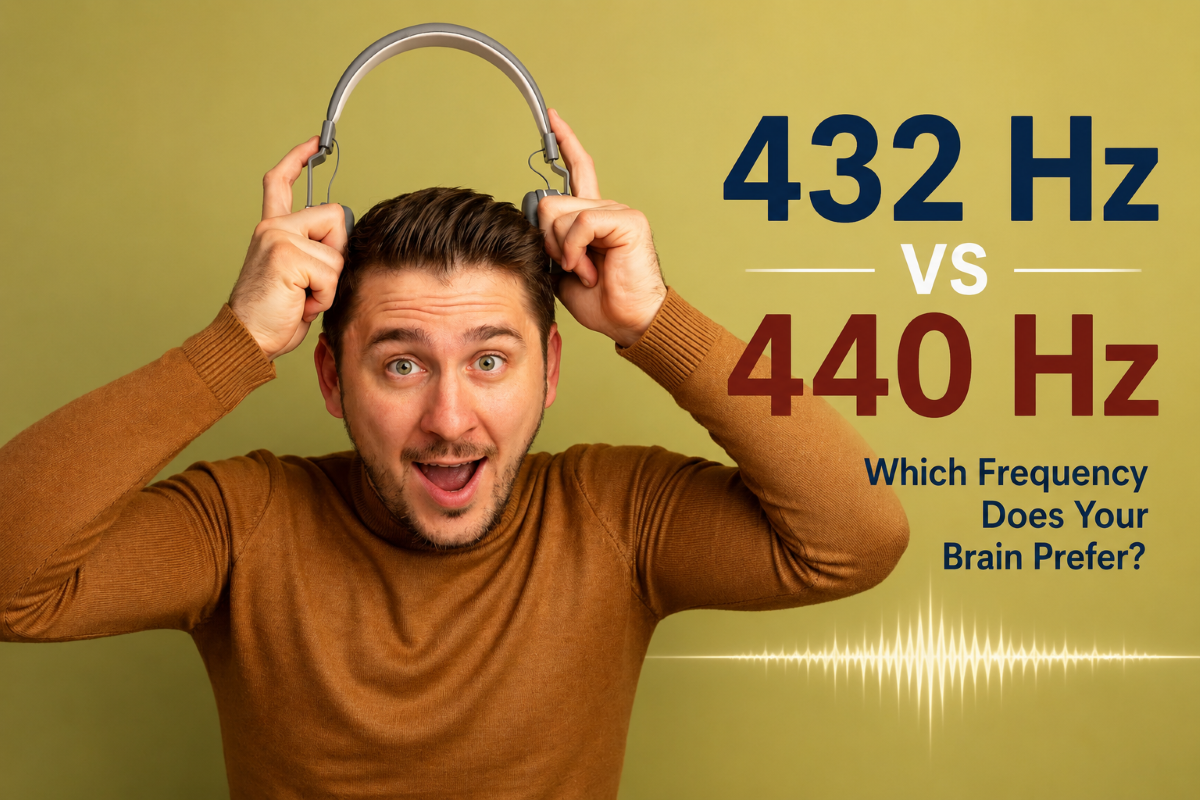
Music has the power to change our mood, influence our emotions, and even affect our physical well-being. But what if the frequency behind the music you listen to could make a difference too? In recent years, the debate between 432 Hz and 440 Hz has exploded across social media, wellness communities, and among music enthusiasts worldwide.
Some claim that 432 Hz is more natural and relaxing, while others argue that 440 Hz remains the gold standard for music. So what is the truth, and is one frequency actually better for humans?
What Is Frequency in Music?
Frequency is measured in Hertz (Hz), which represents the number of vibrations occurring each second. In music, frequency determines the pitch of a note. For example, when musicians tune to 440 Hz, the note A above middle C vibrates 440 times per second.
Today, 440 Hz is the internationally accepted standard used by orchestras, recording studios, and musicians around the world. However, a growing number of artists and listeners are exploring music tuned to 432 Hz because of its perceived calming effects.
Why Is 432 Hz So Popular?
Supporters of 432 Hz believe it creates a softer and more harmonious listening experience. Many listeners describe music tuned to 432 Hz as warmer, smoother, and less aggressive compared to music tuned to 440 Hz.
The popularity of 432 Hz is often linked to the idea that it aligns more closely with natural patterns found in the world around us. Some enthusiasts connect it to the Earth’s natural electromagnetic frequency, known as the Schumann Resonance, while others point to mathematical patterns found in nature and sacred geometry.
Although these claims remain scientifically debated, many people report feeling more relaxed and emotionally connected when listening to music tuned to 432 Hz.
What Does Science Say?
Research on the effects of music frequencies is still developing, but some studies suggest that music tuned to 432 Hz may promote relaxation and slightly lower heart rates compared to music tuned to 440 Hz.
Scientists believe that any benefits may come from the subtle change in pitch rather than from any special or mystical property of the number itself. The difference between 432 Hz and 440 Hz is relatively small, yet sensitive listeners can often notice it.
While there is no conclusive evidence proving that 432 Hz is superior, there is also no doubt that music can significantly influence stress levels, mood, and emotional well-being.
The Frequencies Humans Hear Best
The human ear does not respond equally to all frequencies. In fact, our hearing is most sensitive between 2,000 Hz and 5,000 Hz. This range contains many of the sounds crucial for understanding speech and communication.
For music and everyday listening, frequencies between 250 Hz and 2,000 Hz are often perceived as rich, pleasant, and comfortable. This range includes many of the tones found in vocals, pianos, guitars, and other popular instruments.
Because of this natural sensitivity, certain sounds can feel more enjoyable or emotionally engaging than others.
Can Sound Improve Relaxation and Focus?
Many people use specific frequencies to support relaxation, meditation, and concentration. Music tuned to 432 Hz is commonly used during yoga sessions, mindfulness practices, and relaxation exercises because listeners often describe it as soothing.
Another popular frequency is 528 Hz, sometimes called the “love frequency.” While scientific evidence for extraordinary healing effects remains limited, some studies suggest that listening to calming music tuned around this frequency may help reduce stress and improve mood.
Brainwave frequencies also play a role in focus and relaxation. Alpha brainwaves, which range from 8 to 13 Hz, are associated with calm awareness and reduced anxiety. Beta brainwaves, ranging from 12 to 20 Hz, are linked to concentration, problem-solving, and productivity.
This is why binaural beats and frequency-based audio tracks have become increasingly popular among students, professionals, and meditation practitioners.
So Which Frequency Is Better?
The answer depends largely on personal preference and your goals.
If you enjoy bright, energetic, and modern recordings, 440 Hz may sound perfect to you. If you prefer a softer, more relaxed listening experience, 432 Hz could feel more comfortable.
What matters most is not the number itself but how the music makes you feel. Tempo, melody, rhythm, and emotional connection often have a much greater impact than a small difference in tuning frequency.
Still, with millions of listeners reporting positive experiences with 432 Hz music, it may be worth putting on your headphones and discovering the difference for yourself.
The best frequency for humans may not be a single number at all. It may simply be the sound that helps you feel your best.