
If it feels like tick season starts earlier every year and lasts longer than it used to, you are not imagining it. Across North America, experts are warning that ticks are becoming more active as temperatures rise, winters stay milder and outdoor exposure increases. That does not mean a dramatic movie-style invasion is suddenly sweeping the whole continent, but it does mean that in many regions, the risk of tick bites is becoming harder to ignore.
Ticks are most active when conditions are warm enough for them to leave the ground cover and begin searching for a host. Public health guidance in both the United States and Canada highlights spring through early fall as the key risk period, though ticks can remain active outside that window when temperatures stay above freezing. That is why more people are being told to think about tick protection much earlier in the year and not only in the middle of summer
In North America, the biggest health concern is not that ticks are “aggressive” in the dramatic sense, but that some species are efficient at finding hosts and can carry serious infections. Blacklegged ticks, also known as deer ticks, are the main carriers of the bacteria that cause Lyme disease. In Canada, surveillance data continue to show that blacklegged ticks and western blacklegged ticks are the primary species of concern, while American dog ticks are also commonly found on pets and people, depending on the region.
Lyme disease remains the best-known tick-borne illness, but it is not the only one. Health authorities also warn about anaplasmosis, and researchers in Canada continue to monitor pathogens found in ticks collected from animals and the environment. One Canadian surveillance source found Borrelia burgdorferi, the bacterium behind Lyme disease, in a substantial share of blacklegged tick samples, while anaplasmosis-causing bacteria were less common but still present.
So what can you actually do to protect yourself?
The most effective prevention is still surprisingly simple. Wear long sleeves and long pants when walking through grassy, brushy or wooded areas. Choose light-colored clothing so ticks are easier to spot. Tuck pants into socks, wear closed shoes and stick to cleared paths instead of brushing against tall vegetation. Health authorities also recommend using an EPA-registered repellent with ingredients such as DEET or picaridin, and using permethrin-treated clothing or gear for added protection.
The routine after coming home matters just as much as what you wear outside. Take a shower as soon as possible, check your full body carefully and inspect children, pets, clothing and outdoor gear. Clothes should go into a hot dryer for at least 10 minutes, since heat can help kill ticks that may still be attached to fabric. This small habit can make a real difference, especially after hiking, picnics, camping or even time spent in your own backyard.
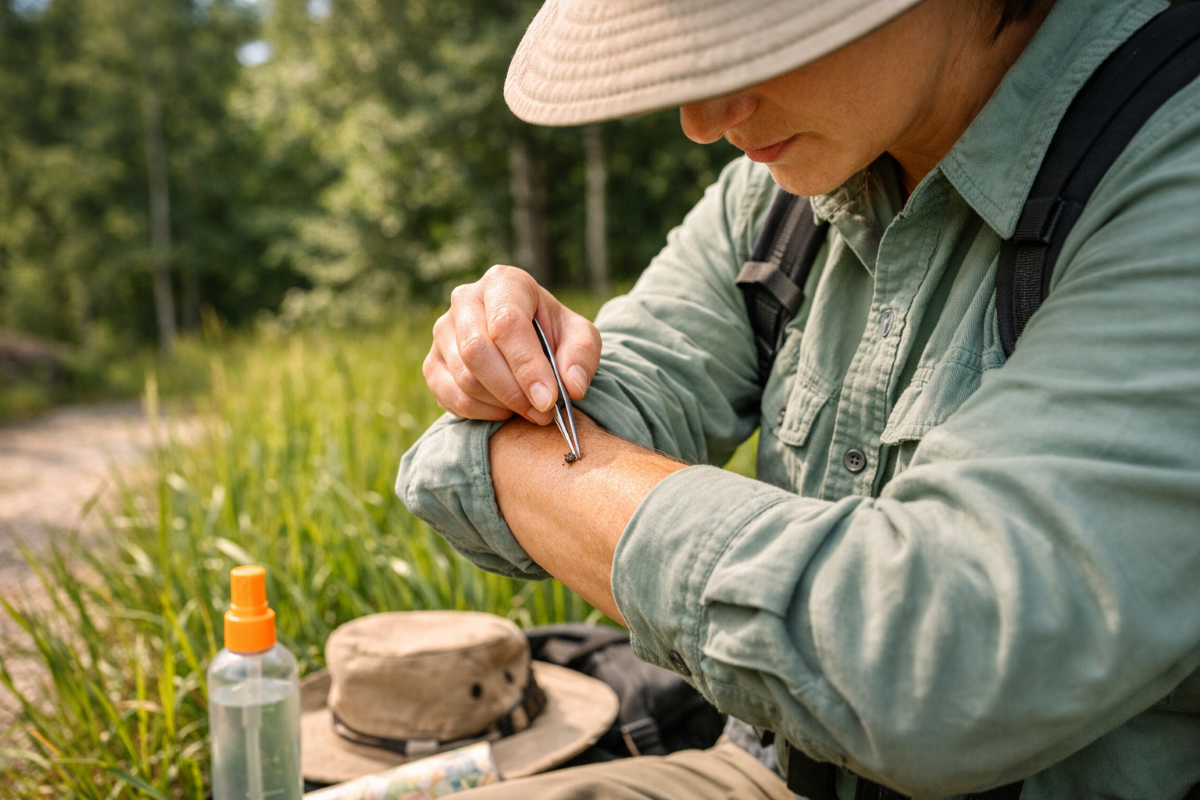
If you do find a tick attached to your skin, do not panic. The key is to remove it as soon as possible. The CDC and other health authorities recommend using fine-tipped tweezers to grasp the tick as close to the skin’s surface as possible and pull upward with steady, even pressure. Do not twist it, crush it or squeeze its body. After removal, clean the bite area and your hands with soap and water, rubbing alcohol or antiseptic. Fast removal matters because in many cases, the infected tick needs to stay attached for at least 24 hours before Lyme disease transmission becomes more likely.
After a bite, watch your body closely over the next days and weeks. A small reddish mark can be normal, but a spreading rash, especially one that looks like a bull’s-eye, is a warning sign. Still, not everyone with Lyme disease develops that classic rash, so flu-like symptoms such as fever, fatigue, headache, muscle aches or joint pain should not be ignored. If symptoms appear, medical advice should be sought quickly because early treatment with antibiotics is important and often very effective.
How about vaccines?
Many people also ask about vaccines. This part needs careful wording. There is currently no human vaccine widely used for Lyme disease in North America. A vaccine against tick-borne encephalitis does exist, and in the United States one product called TICOVAC is available, but tick-borne encephalitis is mainly a travel-related concern tied to endemic parts of Europe and Asia, not the main seasonal tick risk across North America. In Canada, public health guidance states that TBE vaccine is generally available in countries where the disease is present and is mainly relevant for high-risk travellers. That means for most people in the U.S. and Canada, everyday prevention and fast tick removal remain the most important forms of protection.
The bottom line is simple: this is not the summer to ignore ticks. Whether you are taking your dog for a walk, heading to the forest, spending time at the cottage or just sitting in a grassy park, prevention is no longer optional. Tick season is here, and the smartest move is not fear, but preparation. A few small habits can protect your health, your children and your pets all summer long.