
Talent may open a door, but building a career requires something more. For jewelry designer Marlene Haase, succeeding in New York has meant learning to combine creativity with persistence, leadership—and an understanding of the business behind design.
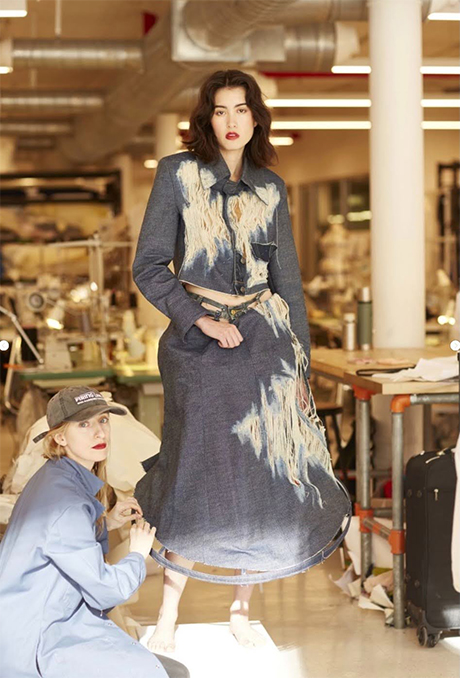
“When I moved to New York, my ambition was to really thrive as a designer and build a career for myself,” Haase says.
She moved to New York after Parsons School of Design selected her for its prestigious MFA Fashion Design and Society program and awarded her a Dean’s Merit Scholarship. She also received a scholarship from the German Academic Scholarship Foundation (Studienstiftung des deutschen Volkes) in recognition of her talent and to support the further development of her career.
New York proved as competitive as she expected. What surprised her was how much she enjoyed that intensity.
“Being surrounded by talented and ambitious people has constantly pushed me to expand the way I think and work as a designer,” she says.
Since arriving in the city, Haase has turned that ambition into a career spanning fashion and fine jewelry. Showing her graduate collection at New York Fashion Week was an early milestone, followed by editorial recognition and professional roles with designers and brands including Melitta Baumeister and Lorraine Schwartz.
As her experience grew, so did her responsibilities. Haase moved into lead designer positions, helping to hire designers and build creative teams.
“I think I was trusted with these roles because I am very dedicated and reliable in my work,” she says. “I take ownership of what I start and make sure I deliver.”
Learning to Lead Creatively
Taking responsibility for a team changed Haase’s understanding of what makes a successful designer.
“Leadership is not only about being a strong designer,” she says. “It also requires communication, collaboration, organization, and understanding how different people work together.”
For Haase, creative leadership begins with structure: clear roles, responsibilities and expectations. Far from restricting creativity, she believes that structure gives people the freedom to concentrate on their strengths.
A good leader also has to understand what motivates different members of a team and create an environment in which people with complementary skills can contribute.
“When there is clarity, trust, and good communication, collaboration becomes much more rewarding and ultimately leads to stronger creative work.”
It is a lesson that also applies to balancing creative ambition with commercial reality. Collections still have deadlines. Clients have expectations. Designs have to make it through prototyping and production.
The Women Who Made Ambition Feel Possible
Haase’s understanding of what a creative career could look like began with the women around her.
Her mother, aunt and grandmother built careers in photography, architecture and illustration. Their example taught her early to trust her ideas and pursue her ambitions.
Later came professors and professional role models, including Lorraine Schwartz, Ofira Sandberg and Melitta Baumeister.
“Seeing women build influential creative businesses has shown me not only what is possible as a female designer, but also how important it is to understand the business side of a creative career and to confidently establish your own place within the industry.”
Confidence, however, developed gradually. Early recognition—including two design scholarships and her acceptance to Parsons School of Design—gave Haase external confirmation that others responded to her work.
But experience taught her that creative ability alone is not enough.
“I think talent is one part of it, but persistence is what really turns it into a career,” she says.
For Haase, that persistence has meant repeatedly taking the next step: completing her BA and MFA, showing at New York Fashion Week, joining established companies and eventually taking on leadership roles.
The other half is learning how creative industries actually function.
“Studying gives you a creative foundation, but working with clients, collections, deadlines, and production teaches you how to turn creative ideas into something that works in the real world.”
Her advice to young women hoping to follow a similar path is therefore practical: seek strong education and experience. Collaborate. Build relationships. Learn how to communicate and organize. And deliver.
“Design is not only about creativity—it is also a creative business,” she says.
For Haase, the next challenge is to continue developing jewelry collections, experimenting with unexpected material combinations and creating larger creative worlds around them.
Her ambitions are still evolving. But the lesson of her New York career is already clear: creative talent matters. Building something from it requires the confidence to be seen, the discipline to deliver, and eventually, the ability to help other people do their best work too.