
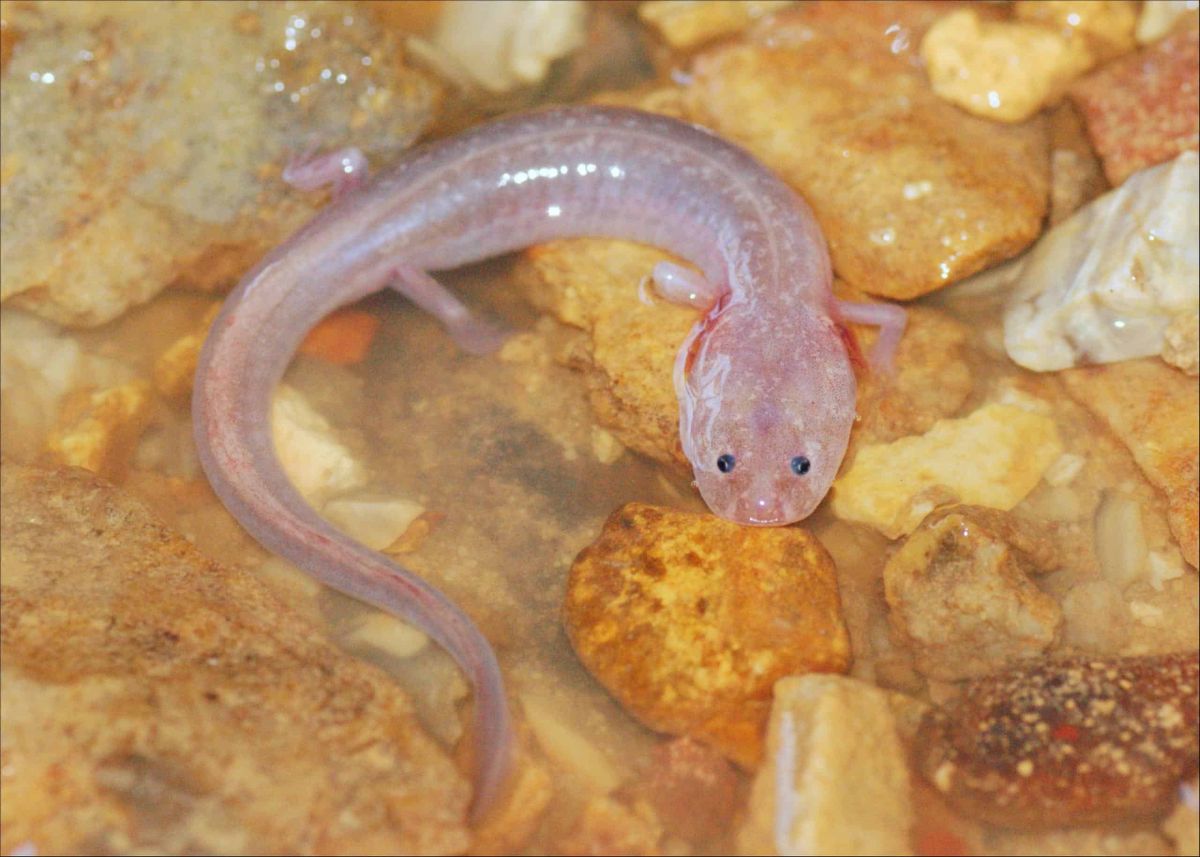
When the Balkans get hit by days of heavy rain, the damage we see is obvious: flooded streets, landslides, closed roads, soaked homes. But in Dalmatia, Croatia, the same storms recently revealed something most people will never see in their entire lives: pale, ghost-like amphibians known as the “human fish,” suddenly appearing where they simply don’t belong.
The “human fish” isn’t a fish at all. Its real name is Proteus anguinus, also called the olm, a Dinaric endemic that lives in the groundwater world of the Dinaric karst, in caves, pits, and underground streams where darkness is permanent and conditions barely change. That stability is exactly why it survives there, and exactly why it struggles anywhere else.
So how does a creature that spends its life in underground water suddenly end up on the surface?
After prolonged rainfall, groundwater levels rise and pressure pushes water through cracks and channels in the karst, sometimes “flushing” animals out of their hidden habitat and into springs, streams, or even puddles near the surface. Croatian institutions and media reported that this is what happened in parts of Split-Dalmatia County, where multiple individuals were found outside their natural environment.
It sounds dramatic, but it’s also brutally risky for the olm.
The moment an olm is thrown into surface conditions, it faces a triple shock: light, warmer temperatures, and a completely different microbial world. Experts involved in the rescue warned that one of the biggest dangers is infection, because the olm’s organism is adapted to the stable underground environment, and contact with surface water and microorganisms can be fatal.
That’s why the response in Croatia focused on speed and caution. Staff from the public institution “More” went into the field, collected multiple individuals, and coordinated with professionals from Zagreb Zoo to place them in controlled conditions designed to match their natural habitat as closely as possible. Zagreb Zoo has experience caring for olms through its long-running conservation work, which includes rescuing individuals from flooded areas and studying them using non-invasive methods.
Here’s the part that makes this story bigger than a single rescue.
The olm is not just an unusual animal. It’s a living indicator of groundwater health. It inhabits the same underground water systems that many communities depend on, which means pollution, habitat disruption, and changes in water regimes can hit the species fast, sometimes before we notice broader consequences.
And the Dinaric karst is famously sensitive. Water moves through it quickly, filtering is limited compared to many other landscapes, and what enters the system can spread far. That’s why institutions stressed that events like this are reminders of how fragile the underground world is, and how important coordinated professional action is when something goes wrong.
It’s also a rare chance for science to learn without disturbing the underground itself. In caves and deep karst channels, research is difficult, slow, and often limited by access. In controlled settings, experts can monitor health, behavior, and diet, building knowledge that’s nearly impossible to collect in the wild underground environment.
If you’re wondering whether “flushing” will keep happening, the answer is yes. It’s described as a natural phenomenon that occurs periodically, often connected to extreme hydrological events. But that doesn’t make it harmless, especially if storms become more intense or more frequent, or if karst waters are already stressed by pollution and human pressure.
What should someone do if they ever see one?
The safest rule is simple: don’t treat it like a curiosity to handle, and don’t assume you’re helping by moving it yourself. These animals are extremely vulnerable to contamination and stress. The right move is to alert local environmental services, rescue teams, or wildlife professionals who can respond with proper protocols, like the teams that acted in Dalmatia.
For most of us, the “human fish” will remain a myth-like creature we read about online. But for Croatia, this moment turned into a real-life reminder: beneath the roads, the cities, and the tourist coastline, there’s an ancient, hidden ecosystem that depends on balance. One flood was enough to pull that world into daylight, and to show how quickly it can be disrupted.